Explore the primary rf coaxial cable uses across telecommunications, medical, and aerospace industries. Learn how impedance and shielding impact signal performance.
Radio Frequency (RF) coaxial cables serve as the backbone of modern high-frequency communication. Unlike standard electrical wires, these cables are engineered to transmit electromagnetic signals with minimal interference and low signal loss. Whether it is the cellular signal reaching your smartphone or the high-resolution images on a diagnostic medical monitor, RF coaxial cables facilitate the precise movement of data through challenging environments.
Understanding rf coaxial cable uses requires looking beyond the outer plastic jacket. To appreciate why they are indispensable in industrial and commercial sectors, we must examine their unique architecture and how it solves the problem of signal degradation over distance.
The Engineering Logic Behind RF Coaxial Cables
An RF coaxial cable is defined by its four-layer concentric structure: a central conductor, a dielectric insulator, a metallic shield, and an outer jacket. This "coaxial" geometry ensures that the magnetic and electric fields remain trapped within the dielectric.
The primary purpose of this design is shielding. In industrial environments where electromagnetic interference (EMI) is high—such as factory floors with heavy machinery—standard twisted-pair cables often fail. RF coaxial cables maintain signal integrity by blocking external noise while preventing the signal inside the cable from radiating outward and interfering with other sensitive electronics.
Primary RF Coaxial Cable Uses Across Key Industries
The versatility of RF cables stems from their ability to handle a wide range of frequencies, from low-frequency radio to high-frequency microwave signals.
1. Telecommunications and Wireless Infrastructure
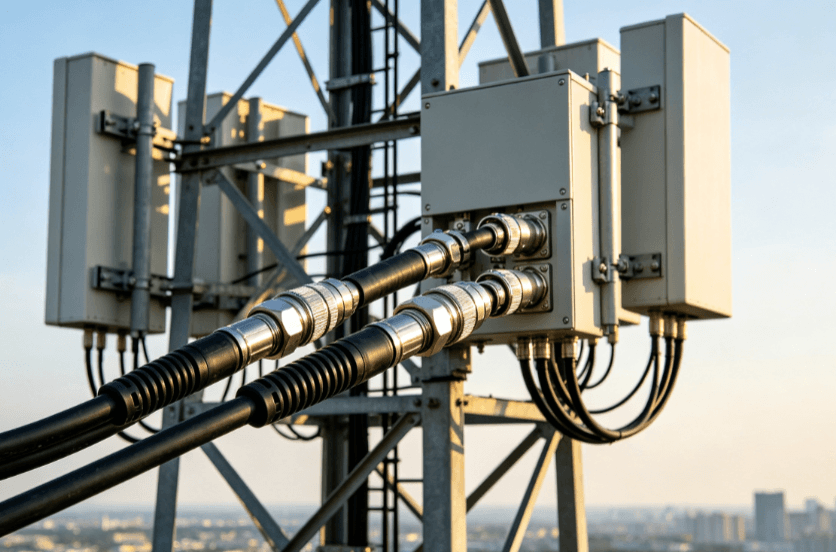
In the telecommunications sector, RF cables are the primary link between high-power transmitters and antennas.
- Base Stations: Mobile networks (4G and 5G) rely on low-loss coaxial cables to connect Remote Radio Heads (RRH) to antennas.
- Satellite Communications: Earth stations use high-precision RF cables to transmit data to orbiting satellites, requiring materials that can withstand outdoor temperature fluctuations and UV exposure.
- Distributed Antenna Systems (DAS): Within large buildings like airports or stadiums, RF cables distribute cellular signals to ensure consistent coverage in "dead zones."
2. Medical Diagnostic Equipment
Precision is non-negotiable in the medical field. RF coaxial cables are essential components in:
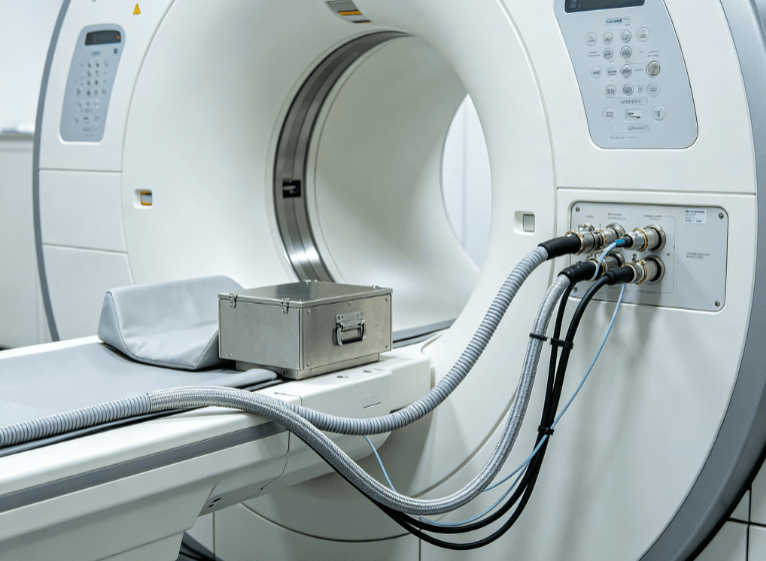
- MRI Machines: Magnetic Resonance Imaging uses powerful RF pulses to generate images. The cables must handle high power while maintaining extreme shielding to avoid distorting the sensitive data.
- Surgical Lasers and Ablation Tools: These devices use high-frequency energy to perform delicate procedures, requiring flexible, small-diameter RF cables that do not compromise signal strength.
3. Aerospace and Defense
In aviation and defense, RF cables must meet rigorous standards like MIL-DTL-17.
- Radar Systems: Both ground-based and airborne radar systems use coaxial cables to send and receive pulses that detect objects.
- Avionics: Modern cockpits are packed with electronic systems. RF cables connect navigation, communication, and electronic warfare (EW) suites, often using high-temperature resistant materials like PTFE (Teflon).
4. Industrial Automation and IoT
As factories move toward Industry 4.0, the need for reliable data transmission increases. RF coaxial cable uses in this sector include connecting IoT sensors to gateways and ensuring that automated robotic arms receive real-time commands without lag or interference.
How Impedance Determines the Application
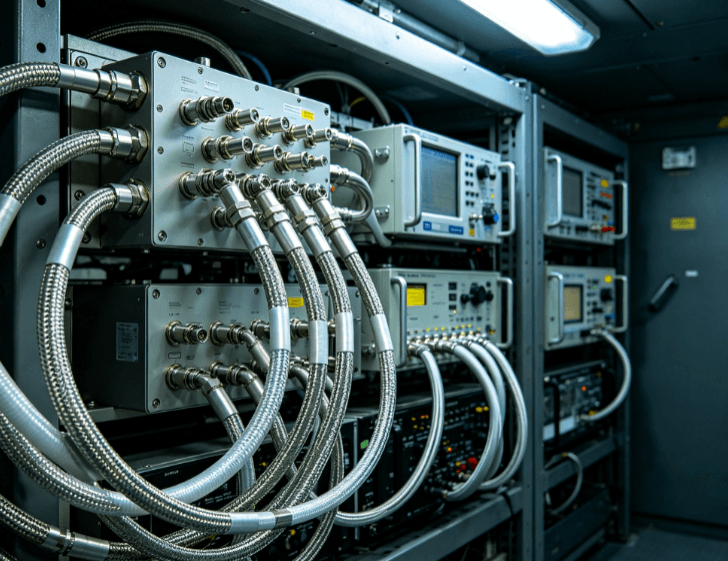
Not all RF cables are created equal. The application usually dictates the "characteristic impedance" required, typically measured in Ohms (Ω).
| Impedance |
Primary Use Cases |
Common Cable Types |
| 50 Ohm |
Wireless communication, high-power RF transmission, laboratory testing, Wi-Fi routers. |
RG-58, RG-174, LMR-400 |
| 75 Ohm |
Video transmission, Cable TV (CATV), digital audio, high-definition video broadcasting. |
RG-6, RG-59, RG-11 |
50-Ohm cables are the industry standard for data and radio transmission. They offer a balance between power handling and low signal loss. In contrast, 75-Ohm cables are optimized for low loss over long distances specifically for video signals, which is why they are found in residential television setups and professional broadcasting studios.
Performance Factors to Consider
When evaluating an RF coaxial cable for a specific project, engineers focus on several critical performance metrics:
- Attenuation (Signal Loss): This is the reduction in signal strength as it travels through the cable. High-frequency signals attenuate faster than low-frequency ones. For long-distance runs, larger cables with high-quality dielectrics are necessary.
- Velocity of Propagation (VoP): This indicates how fast the signal travels through the cable relative to the speed of light. High VoP is crucial in timing-sensitive applications like GPS synchronization.
- Shielding Effectiveness: Expressed in decibels (dB), this measures how well the cable prevents EMI. For high-density electronic environments, "double-shielded" or "tri-shielded" cables are often mandatory.
- Power Handling: In transmission applications, the cable must be able to dissipate heat generated by the RF energy without melting the dielectric.
Choosing the Right Cable for the Environment
The physical environment often dictates the choice of outer materials. For example, cables used in military or aerospace applications often utilize FEP or PFA jackets for chemical and flame resistance. In contrast, outdoor telecommunication cables might use Polyethylene (PE) for superior moisture and UV protection.
For specialized industrial needs, manufacturers like Soarcable provide a range of RF solutions, including the RG series (RG-58, RG-174, RG-316) and low-loss LMR-equivalent cables. These are designed to meet specific tolerances required for OEM integration and precision instrumentation. Selecting a cable involves matching the electrical requirements (frequency and impedance) with the mechanical constraints (flexibility and durability).
Summary of Benefits
The enduring popularity of the RF coaxial cable is due to its "self-contained" nature. Because the electromagnetic field is confined between the inner and outer conductors, the cable can be bent, strapped to metal supports, or run alongside power lines without significantly affecting the signal—a feat that simpler wires cannot achieve.
FAQ
Q: Can I use a 75-Ohm cable for a Wi-Fi antenna?
A: It is not recommended. Wi-Fi equipment is designed for 50-Ohm impedance. Using a 75-Ohm cable will cause a "mismatch," leading to Signal Standing Wave Ratio (SWR) issues, signal reflections, and potential damage to the transmitter.
Q: Why are some RF cables much thicker than others?
A: Generally, thicker cables have lower attenuation (signal loss). Larger central conductors and thicker dielectrics allow signals to travel further at higher frequencies. Smaller cables like RG-174 are used when space is limited and distances are short.
Q: What is the difference between "Flexible" and "Semi-Rigid" RF cables?
A: Flexible cables use braided wire shields and are used for general applications. Semi-rigid cables use a solid copper outer tube as a shield; they offer superior shielding and performance at microwave frequencies but are difficult to bend and are typically used inside permanent assemblies like satellite components.
Q: Does the length of the RF cable affect its performance?
A: Yes. Every foot of cable adds a specific amount of signal loss (attenuation). In high-frequency applications, engineers always aim for the shortest possible cable run to maximize signal strength.
Reference Sources
- IEEE (Institute of Electrical and Electronics Engineers): Standards for RF transmission and microwave theory. ieee.org
- MIL-DTL-17 Specifications: The United States military standard for coaxial cable performance and testing.
- ANSI/TIA-568: Commercial building telecommunications cabling standards. tiaonline.org
- International Electrotechnical Commission (IEC): IEC 61196 series for coaxial communication cables. iec.ch


