Explore the essential types of wire harness in cars, from powertrain and body harnesses to high-voltage EV systems. Learn how automotive harness types impact vehicle architecture, signal integrity, and manufacturing complexity.
The modern vehicle is no longer just a mechanical machine; it is a sophisticated mobile data center. At the heart of this transformation is the automotive wiring harness—the "central nervous system" that facilitates the flow of energy and information between sensors, actuators, and electronic control units (ECUs).
As vehicles transition toward electrification and autonomous driving, the complexity of these harnesses has increased exponentially. A standard luxury vehicle today can contain upwards of 3,000 meters of wiring, weighing nearly 50kg. Understanding the various automotive harness types is critical for engineers, OEM project managers, and system integrators who must balance weight, signal integrity, and thermal management within the cramped confines of a chassis.

Categorizing Automotive Wiring Harnesses by Functional Subsystems
The most common method to classify types of wire harness in a car is by their functional location and the specific environmental stressors they must endure. Each subsystem requires unique insulation materials, connector types, and shielding protocols.
1. Engine and Powertrain Harness
The engine harness is perhaps the most demanding automotive harness type. It connects the ECU to engine sensors (oxygen, temperature, pressure) and actuators (fuel injectors, ignition coils).
- Environmental Challenges: This harness must withstand extreme temperatures (often exceeding 125°C to 150°C) and constant vibration.
- Technical Specification: Engineers typically specify high-performance insulation like Cross-linked Polyethylene (XLPE) or Tefzel (ETFE) to prevent melting and chemical degradation from oil, fuel, and coolant.
2. Body and Chassis Harness
The body harness acts as the backbone of the vehicle’s electrical architecture. It stretches from the front to the rear, powering lighting systems (headlights, taillights), power windows, door locks, and internal cabin components.
- Layout Logic: Due to its length, the primary concern here is voltage drop. Large-gauge copper wiring is often used for power distribution, while thinner twisted pairs handle signal data.
- Complexity: In modern SUVs and sedans, the body harness is often modular to allow for different trim levels (e.g., adding a sunroof or heated seats) without redesigning the entire circuit.
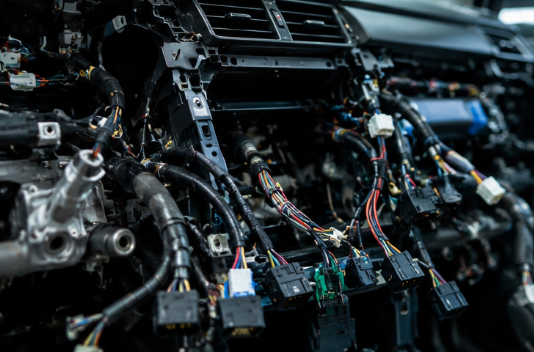
3. Cockpit and Dashboard Harness
This harness manages the Human-Machine Interface (HMI). It connects the instrument cluster, infotainment system, HVAC controls, and airbags.
- Signal Integrity: Because it handles high-speed data for touchscreens and audio systems, these harnesses often include shielded cables or LVDS (Low-Voltage Differential Signaling) wires to prevent Electromagnetic Interference (EMI).
- Space Constraints: Cockpit harnesses are densely packed behind the dashboard, requiring high-pin-count connectors and precise routing to avoid "squeak and rattle" issues.
-
Classification by Voltage: The Shift to Electrification
With the rise of Electric Vehicles (EVs) and Hybrid Electric Vehicles (HEVs), a new classification of wiring has emerged based on voltage levels.
| Harness Type |
Typical Voltage |
Application |
Identification |
| Low Voltage (LV) |
12V / 24V |
Sensors, lighting, ECUs, infotainment. |
Standard multi-colored insulation. |
| High Voltage (HV) |
400V - 800V |
Battery packs, inverters, electric motors. |
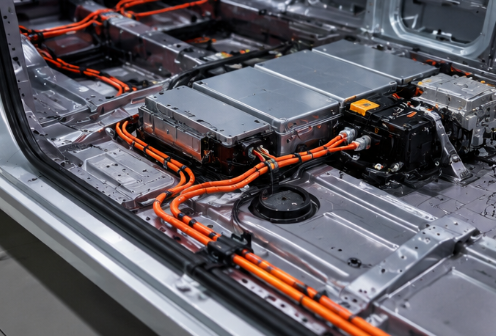
Orange insulation (Industry Standard). |
High-Voltage (HV) Harnesses represent a major leap in manufacturing technology. Unlike standard 12V systems, HV harnesses require heavy-duty EMI shielding to protect low-voltage signals from the massive electromagnetic fields generated by the drive motor. They also utilize specialized high-voltage interlock loops (HVIL) to ensure the system is de-energized if a connector is unplugged, ensuring technician safety.
Advanced Architectures: From Point-to-Point to Zonal Wiring
The evolution of automotive harness types is also defined by how they are architecturally organized. Traditionally, cars used a Point-to-Point or Centralized Architecture, where every sensor was wired directly to a central ECU. This led to massive, heavy, and difficult-to-install "harness bundles."
Zonal Architecture
To reduce weight and complexity, many OEMs (such as Tesla and Volvo) are moving toward Zonal Architecture.
- How it works: Instead of long runs from the front to the back of the car, the vehicle is divided into "zones" (e.g., Front-Left, Front-Right, Rear).
- Benefit: Local sensors connect to a nearby "Zonal Gateway," which then communicates with the central computer via high-speed Ethernet. This significantly reduces the total length of the wire harness and simplifies the manufacturing process.
Materials and Manufacturing Standards in Automotive Harnessing
Selecting the right automotive harness type requires a deep understanding of material science and international standards.
- Conductor Materials: While copper remains the standard due to its conductivity, aluminum wiring is increasingly used in battery cables and large-power distribution lines to reduce weight, despite its lower conductivity and termination challenges.
- Shielding and Protection: Automotive environments are electrically "noisy." To maintain signal clarity for Advanced Driver Assistance Systems (ADAS) like cameras and LIDAR, harnesses utilize braided shielding or foil wrapping.
- Regulatory Compliance: Any high-quality automotive harness must adhere to global standards such as IATF 16949 for quality management and ISO 26262 for functional safety. At the component level, connectors and wires often meet SAE (Society of Automotive Engineers) or USCAR specifications.
Companies specializing in custom connectivity, such as those providing advanced cable assemblies, focus on ensuring these harnesses meet specific IP (Ingress Protection) ratings for water and dust resistance, especially for external sensors and under-chassis routing.
Key Considerations for Engineering and Integration
When determining which types of wire harness in a car are suitable for a specific project, engineers must evaluate:
- Bend Radius: In tight spaces like door hinges (A-pillars) or steering columns, the harness must have a high flex life without breaking the internal copper strands.
- Thermal Management: Harnesses located near exhaust systems or turbochargers require heat shields or specialized tape (such as Kapton or silicone-coated fiberglass).
- Terminal Integrity: Most "electrical failures" in vehicles are actually mechanical failures at the connector. Choosing the right terminal plating (tin, silver, or gold) is essential to prevent oxidation and fretting corrosion.
Conclusion
The diversity of automotive harness types reflects the increasing complexity of modern transportation. From the heat-resistant engine harness to the high-bandwidth data cables required for autonomous driving, each system is a precision-engineered component. As the industry moves toward 800V EV architectures and zonal computing, the wiring harness will continue to evolve from a simple "dumb" component into a high-performance integrated system.
For manufacturers and engineers, staying ahead of these trends is not just about connectivity—it is about ensuring the safety, efficiency, and longevity of the vehicle.
FAQ
Q: Why are high-voltage automotive harnesses always orange?
A: The orange color is a standardized safety visual cue used globally to alert emergency responders and technicians that the cables carry high-voltage electricity (usually above 60V DC), which can be lethal if handled incorrectly.
Q: What is the difference between a wire and a harness?
A: A wire is a single conductor. A harness is an organized assembly of multiple wires, cables, and connectors, often wrapped in conduit or tape, designed to transmit power and signals through a specific route in a vehicle.
Q: How does a CAN bus affect the type of wire harness used?
A: The Controller Area Network (CAN bus) allows multiple microcontrollers to communicate using only a single pair of twisted wires. This significantly reduces the number of automotive harness types needed by eliminating the need for dedicated wires for every individual signal.
Q: Can aluminum replace copper in all car harnesses?
A: No. While aluminum is lighter and cheaper, it is less conductive and more prone to corrosion and vibration fatigue. It is currently used primarily for heavy battery cables rather than delicate sensor wiring.
Reference Sources


