

2026-11-13
A custom cable assembly for OEM equipment should arrive ready for the intended installation, with the correct interfaces, wiring, dimensions and identification. Achieving that starts with a specification package that engineering, purchasing and the manufacturer can all use.
The practical route is to define the assembly, close quotation assumptions, approve representative samples and release production against an agreed revision. This guide sets out the information and approval steps needed along that route.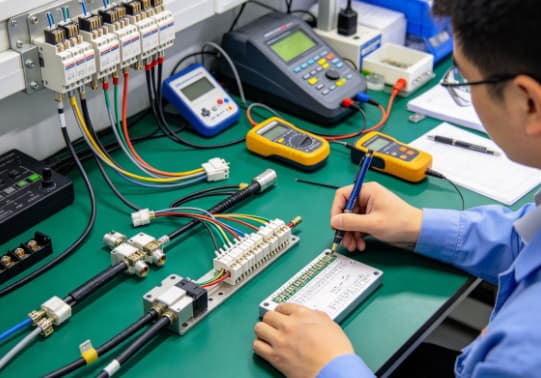
SOAR’s industrial cable collection and telecommunication cable collection provide starting references for equipment connections. Use a relevant product to explain the assembly type, then attach the documents defining your actual requirement.
| RFQ item | Information to include | What it prevents |
|---|---|---|
| Interfaces | Connector and mating-part numbers, gender, keying and cable-exit direction | Incorrect mating or installation conflicts |
| Electrical definition | Pin-to-pin table, circuit ratings, signal pairs and shield connections | Unclear wiring or signal requirements |
| Cable construction | Cable specification, jacket, protection and operating conditions | Material assumptions that do not match the installation |
| Mechanical drawing | Lengths, tolerances, reference points, branches and strain relief | Assemblies that connect electrically but do not fit |
| Identification and acceptance | Labels, inspection criteria, test records and packaging | Unclear delivery acceptance and part identification |
| Order scope | Prototype quantity, production quantity, forecast and required dates | Quotations based on different purchasing assumptions |
For example, SOAR lists a HARTING iX industrial Ethernet cable. When discussing an equipment connection of this type, confirm both interfaces, cable construction, length and required communication performance. The product name alone does not define every order detail. 
Ask the manufacturer to identify missing information, proposed substitutions and any drawing details that need review. Record the answers in a revised drawing, BOM or agreed specification rather than leaving important decisions scattered across emails.
A quotation should identify the revision being priced. If an alternative component is proposed, request its exact part number and approve it before it becomes part of the sample build.
Check mating, connector access, routing, branch lengths, mounting and label visibility. Run the electrical and functional checks agreed for the application. Record any deviations and the actions needed before production.
Confirm whether samples use the planned production materials and process. A hand-built prototype may prove fit while leaving production tooling or repeatability to be verified in a pilot run.
Reference the approved part number, drawing revision, BOM and sample status in the purchase order or release package. Separate approval to procure long-lead components from authorization to manufacture finished assemblies.
For a custom cable assembly for OEM equipment, this distinction helps purchasing and engineering agree what work can proceed while remaining requirements are closed.
Define which checks apply to each unit, which use samples and which form part of design validation. Record test limits, inspection frequency and required reports before sample approval.
Where IPC/WHMA-A-620 acceptance criteria are specified, identify the agreed revision and product class alongside customer requirements.
The NASA-STD-8739.4 cable and harness workmanship standard provides background for critical cable work; its requirements are not automatically applicable to all OEM equipment.
The UL Solutions Wiring Harness Traceability Program explains cable tracking through manufacture, harness processing and final assembly. If program coverage is required, verify it separately and agree on the documentation needed.
A delivery record should identify the ordered part and revision, the relevant batch or serial reference, and the agreed inspection results.
Ask the quotation to separate unit prices from tooling, test-fixture and other one-time charges. Confirm MOQ for the proposed configuration, sample charges, packaging, delivery terms and quotation validity.
Clarify when the lead-time commitment starts: material availability, sample approval and production release may be separate milestones. Agree on responsibility for custom materials or tooling if the design changes.
For repeat orders, define how component substitutions, process changes and discontinuations will be reported. Keep the drawing, BOM and test requirements aligned under the approved revision, and specify when further sample approval is needed.
Yes. A sample, sketch and interface references can support an initial review. Close the missing dimensions, wiring and acceptance requirements before approving a production build.
Provide the part number, approved revision, quantity and required date. Confirm that materials, construction and inspection requirements remain valid.
To request a custom cable assembly quotation, send the available drawing, BOM, pinout, installation details and quantities. Include your sample-approval and delivery-record requirements so SOAR can review the scope and identify open questions before production.


