2026-10-22
In the high-stakes environment of industrial automation, the difference between a high-performing production line and a maintenance nightmare often comes down to the integrity of the "nervous system"—the wiring harness. While off-the-shelf cables might suffice for basic prototypes, industrial-scale operations require a level of precision, durability, and signal reliability that only custom-engineered solutions can provide.
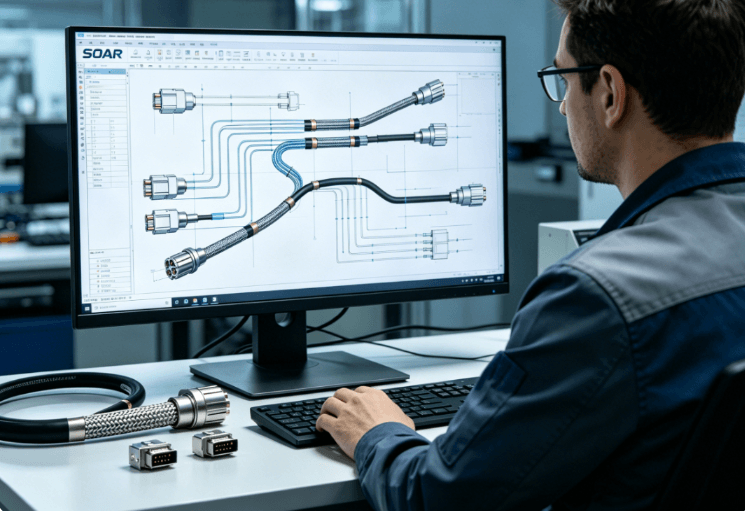
As automation systems move toward higher speeds and greater complexity, engineers are shifting away from generic components. Selecting a SOAR Custom Industrial Wiring Harness is no longer just a procurement choice; it is a strategic engineering decision aimed at mitigating electromagnetic interference (EMI), ensuring physical longevity in harsh environments, and streamlining the assembly of complex PLC and robotic systems.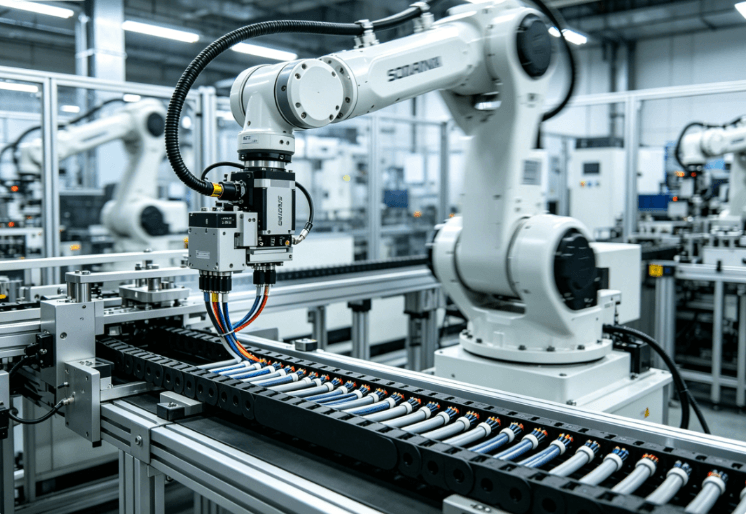
Standardized cables are built for "average" conditions, which rarely exist on a modern factory floor. In an automation cell, cables are subjected to multi-axis torsion, chemical exposure, and high-frequency electrical noise.
When a standard cable fails, the cost is rarely limited to the price of the replacement part. The real impact is measured in unplanned downtime, lost production cycles, and the labor required to troubleshoot a failed connection deep within a cable carrier. Custom harnesses address these vulnerabilities by matching material specifications—such as PUR or PVC jackets—to the specific environmental hazards of the application.
In precision automation, signal degradation is the enemy of throughput. Servo motors, high-speed sensors, and vision systems generate significant electrical noise. A primary advantage of a SOAR Custom Industrial Wiring Harness lies in its tailored shielding architecture.
Depending on the application, a custom harness can utilize:
By optimizing these elements during the design phase, engineers ensure that low-voltage sensor data remains clean, even when routed alongside high-power motor leads.
Industrial robots and linear actuators require cables that can withstand millions of cycles. Generic cables often suffer from "corkscrewing" or conductor breakage when forced into tight-radius drag chains.
SOAR custom solutions focus on the internal architecture of the harness. By using ultra-fine stranded copper and specialized insulation materials like TPE (Thermoplastic Elastomer), these harnesses maintain their structural integrity during continuous bending and torsion. For project managers, this translates to a predictable maintenance schedule rather than reactive repairs.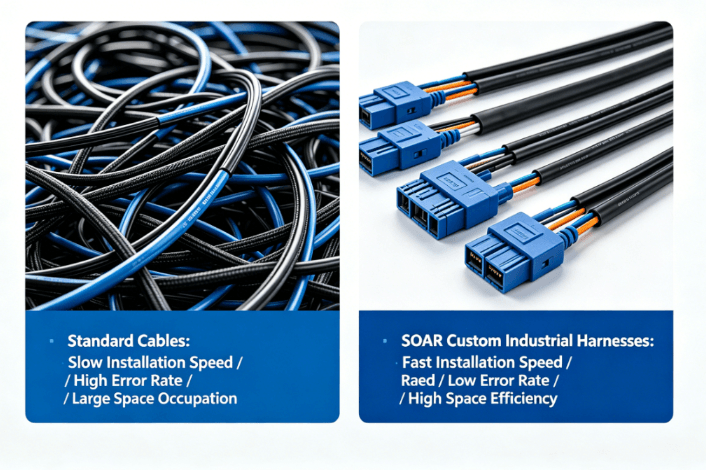
The commercial value of a custom wiring harness is most visible during the installation and maintenance phases. A "plug-and-play" custom assembly significantly reduces labor costs compared to manual point-to-point wiring.
| Feature | Standard Wiring | SOAR Custom Wiring Harness |
|---|---|---|
| Installation Speed | High labor hours (manual stripping/crimping) | Rapid (pre-terminated connectors) |
| Error Rate | Prone to human wiring errors | Error-proof (keyed connectors & labeling) |
| Space Efficiency | Often bulky with excess cable length | Optimized length and compact routing |
| Compliance | General standards only | Application-specific (IP67/UL/CE) |
By utilizing pre-molded M12 or M8 connectors—common in SOAR’s industrial cable collections—manufacturers can eliminate the risk of improper field terminations, which are a leading cause of intermittent signal loss in industrial settings.
Automation doesn't always happen in a cleanroom. Custom harnesses allow for the selection of jacketing materials based on the specific "threat profile" of the facility:
For OEM manufacturers, the transition from design to production requires a partner capable of handling technical complexities while meeting lead-time expectations. Evaluation of a custom harness supplier should focus on:
Choosing a SOAR Custom Industrial Wiring Harness ensures that these manufacturing variables are controlled. With expertise in M-series connectors, waterproof interfaces, and high-flex robotic cables, SOAR provides the technical backbone required for Industry 4.0 applications.
Investing in a custom-engineered harness is an investment in system uptime. While the initial unit cost may be higher than a bulk spool of wire, the reduction in assembly labor, the elimination of wiring errors, and the extended service life provide a far superior ROI. For any automation system where reliability is non-negotiable, custom wiring is the only logical path forward.