

2026-10-22
The modern vehicle is essentially a high-performance computer on wheels. At the heart of this complexity lies the wire harness—the critical "nervous system" that facilitates power distribution and signal communication between sensors, control units, and actuators.
Understanding the SOAR custom automotive wire harness assembly process is vital for engineers and OEM project managers who require high-reliability interconnect solutions. This guide breaks down the technical lifecycle of a harness, from initial design logic to the final quality benchmarks required for automotive environments.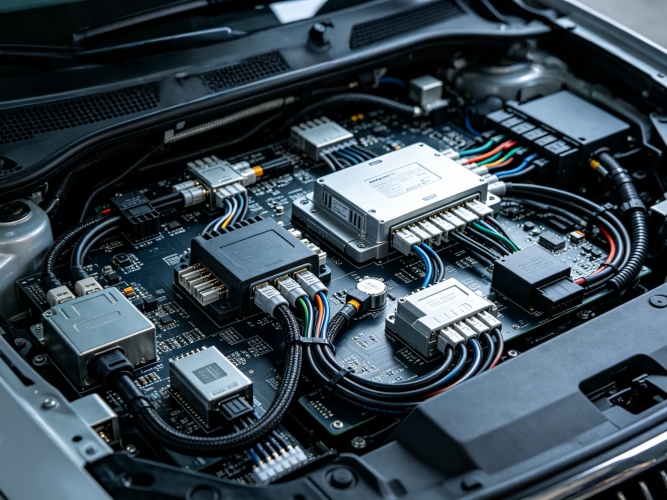
A custom automotive wire harness begins not on the factory floor, but in a CAD environment. Unlike generic electrical bundles, custom assemblies are engineered to fit specific spatial constraints and environmental stressors of a vehicle.
The design phase focuses on:
During this stage, engineers at SOAR utilize detailed Bill of Materials (BOM) to ensure every seal, clip, and terminal meets the application’s specific IP (Ingress Protection) rating.
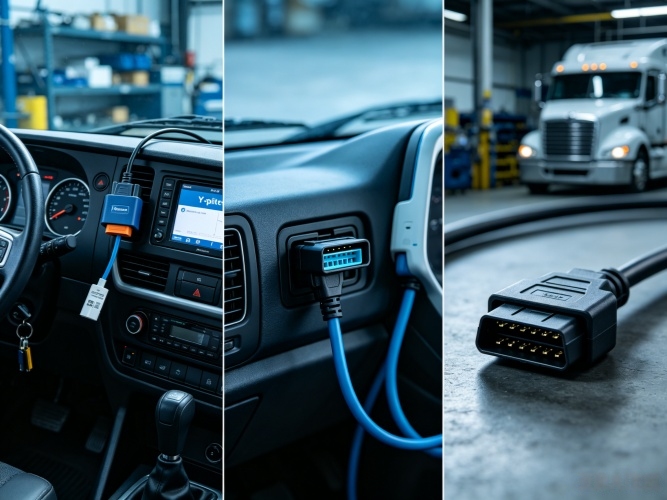
The assembly process starts with high-precision wire processing. In a professional manufacturing environment, manual cutting is replaced by automated CNC units to ensure repeatable accuracy.
The integrity of a wire harness is only as good as its terminations. This is where the electrical connection is physically established.
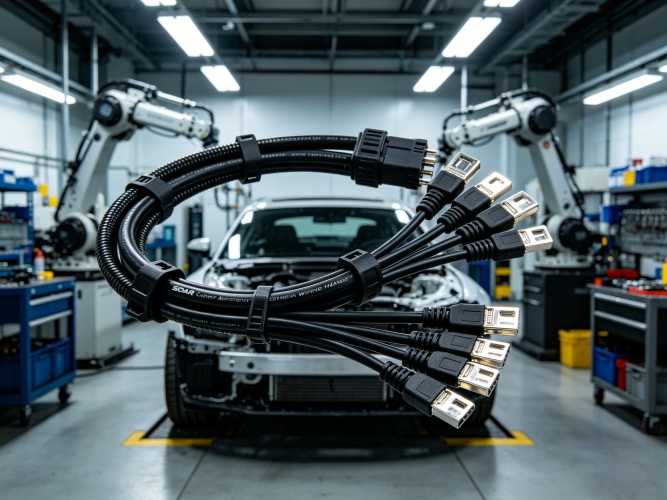
The hallmark of SOAR custom automotive wire harness assembly is the use of a "formboard" or assembly board. This is a full-scale template where the harness is manually or semi-automatically laid out.
| Component | Function in Assembly |
|---|---|
| Harness Board | Defines the 1:1 scale geometry of the harness. |
| Breakout Points | Locations where specific wire branches leave the main trunk. |
| Connector Holders | Fixtures that keep connectors in place for precise wire insertion. |
Assembly technicians follow a "wiring sequence" to place wires into the correct connectors. This phase requires high manual dexterity and strict adherence to the engineering drawing to ensure branches are the correct length for the vehicle’s chassis.
Automotive environments are harsh. Harnesses are subjected to engine heat, road salt, and constant vibration. Protection is not an afterthought; it is a structural requirement.
In the automotive industry, "zero-defect" is the target. Every custom harness must undergo rigorous testing before it is cleared for shipping.
Off-the-shelf solutions rarely suffice in modern vehicle design. Customization allows for:
As vehicle architectures move toward zonal controllers and autonomous driving, the complexity of the harness assembly process continues to evolve. Choosing a manufacturing partner that understands these technical nuances is the first step in ensuring vehicle safety and longevity.
Q: What is the most critical factor in automotive wire harness reliability?
A: Terminal crimp quality. Over 80% of electrical failures in vehicles stem from poor terminations. High-quality assembly processes use automated crimp force monitoring to catch errors in real-time.
Q: How do custom harnesses handle electromagnetic interference (EMI)?
A: In a custom process, engineers use techniques like specific twist-per-inch ratios for data pairs and 360-degree shielding for high-frequency cables to protect sensitive signals from engine noise.
Q: What materials are typically used for automotive wire insulation?
A: Most modern harnesses use XLPE (Cross-linked Polyethylene) or PVC. XLPE is preferred for engine compartments due to its higher temperature resistance and durability against chemicals.
Q: Why is a formboard used instead of just bundling wires?
A: A formboard ensures that every harness produced is identical in physical dimensions. This is crucial for the vehicle assembly line, where the harness must snap into pre-defined clips and connectors on the chassis without being too tight or too loose.


