Discover why automotive OEMs and telematics providers prioritize SOAR Custom OBD2 Cable Assemblies for signal integrity, durability, and specialized pinning.
The landscape of automotive diagnostics has shifted from occasional handheld scanning to continuous, high-speed data transmission via telematics and IoT modules. For original equipment manufacturers (OEMs), a standard off-the-shelf diagnostic cable is rarely sufficient. When integrating fleet management hardware, insurance dongles, or EV charging diagnostic tools, the physical connection becomes a potential single point of failure.
Choosing a SOAR Custom OBD2 Cable Assembly is a strategic decision driven by the need for signal precision, mechanical durability, and project-specific engineering that generic suppliers cannot provide.
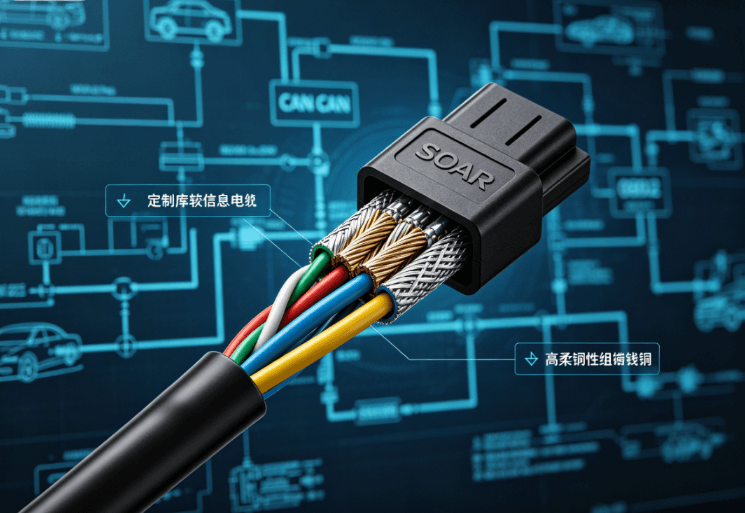
The Engineering Gap: Standard vs. Custom OBD2 Solutions
In a passenger vehicle or heavy-duty truck, the OBD2 port (J1962) serves as the primary gateway to the Controller Area Network (CAN Bus). While consumer-grade cables focus on cost, OEM-spec assemblies focus on reliability over a 10-year lifecycle.
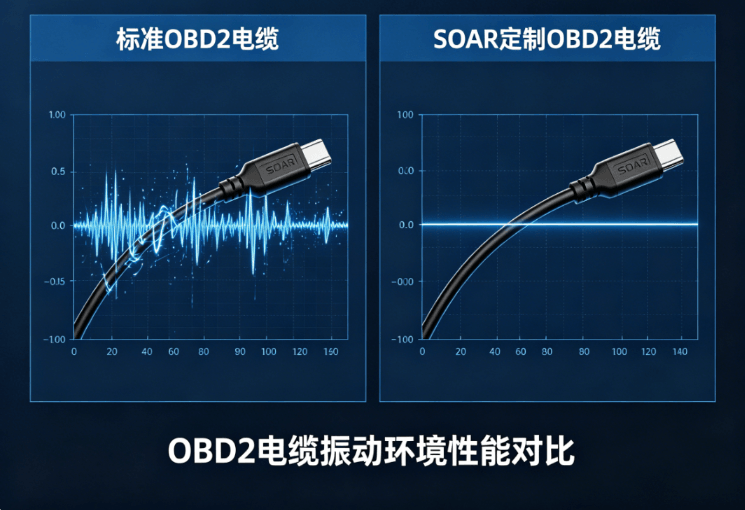
A standard cable often suffers from "signal crosstalk" or packet loss when used in high-vibration environments. For an OEM, this isn't just a technical glitch; it's a liability. Custom assemblies address these risks through controlled impedance, specific wire gauges (AWG), and specialized shielding that protects sensitive data from electromagnetic interference (EMI).
Why Signal Integrity Dictates Assembly Quality
Modern vehicle architectures utilize CAN-High and CAN-Low signals to communicate critical data. If the internal wiring of an OBD2 assembly is not properly twisted or shielded, external noise from the engine’s ignition system or cellular modules can corrupt the data stream.
SOAR Custom OBD2 Cable Assemblies are engineered with:
-
Twisted Pair Wiring: Critical for maintaining the differential signal required by CAN Bus protocols.
-
High-Flex Copper Strands: To prevent internal wire fatigue in tight-radius installations behind dashboards.
-
Optimized Shielding: Options for foil or braided shielding based on the specific EMI profile of the target vehicle environment.
Performance Comparison: OEM Requirements vs. Generic Cables
| Pinout Configuration |
Standard 16-pin pass-through |
Fully customizable (Selective pinning) |
| Material (Jacket) |
Basic PVC |
Automotive-grade TPU or High-Temp PVC |
| Vibration Resistance |
Minimal (Standard friction fit) |
Enhanced with locking mechanisms or overmolding |
| Signal Integrity |
Prone to EMI in industrial use |
Shielded & Twisted-pair optimized |
| Form Factor |
Bulky, generic housing |
Low-profile, right-angle, or ultra-thin |
Advanced Customization for Specialized Applications
One of the primary reasons engineers specify the SOAR Automotive Diagnostic Cable series is the ability to dictate every variable of the build.
1. Low-Profile and Right-Angle Housings
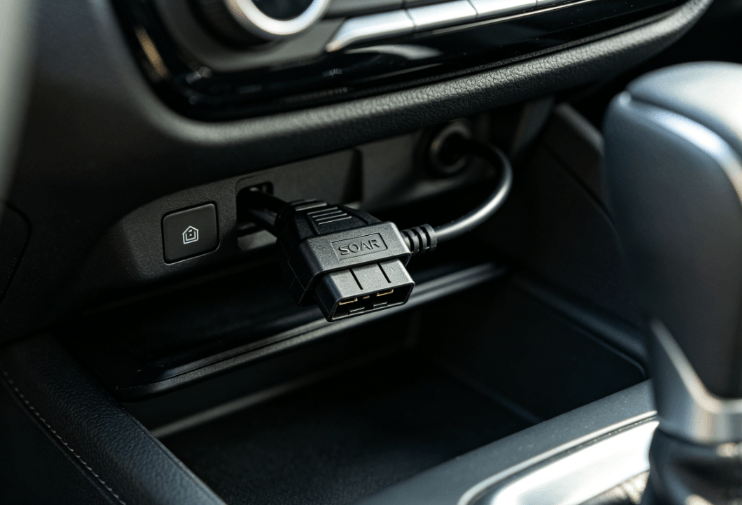
In many fleet management installations, the OBD2 port is located in a position where a standard straight connector would obstruct the driver's knees. OEM customers often require "Low-Profile" right-angle connectors that allow the cable to be tucked away discreetly behind interior panels, ensuring safety and preventing accidental dislodgement.
2. Selective Pinning and Custom Breakouts
Not every application requires all 16 pins of the J1962 protocol. OEM modules often use specific pins for proprietary K-Line communications or power delivery. Custom assemblies allow for "selective pinning," which reduces cable diameter, improves flexibility, and lowers production costs by eliminating unused conductors.
3. Overmolding and Strain Relief
In the automotive world, movement is constant. Standard assembled connectors (using screws or snap-fits) can eventually rattle loose. SOAR utilizes high-pressure overmolding techniques. This process encapsulates the wire-to-pin solder points in a solid resin, making the connection impervious to moisture, dust, and continuous mechanical vibration.
Materials Matter: Surviving the Automotive Environment
Automotive cabins are harsh environments. Components must survive temperature swings from -40°C in winter to +85°C in a vehicle parked under direct summer sun.
OEM-grade OBD2 assemblies utilize TPU (Thermoplastic Polyurethane) or specialized TPE (Thermoplastic Elastomer) jackets rather than cheap PVC. These materials provide:
-
Chemical Resistance: Protection against interior cleaners, oils, and automotive fluids.
-
Flame Retardancy: Compliance with UL94V-0 or specific automotive fire safety standards.
-
Cold Flex Performance: Ensuring the cable doesn't become brittle and crack in sub-zero temperatures.
The Importance of Compliance and Testing
For an OEM procurement manager, the "cheapest" cable often becomes the most expensive after a product recall or a field failure. Trustworthiness in the B2B supply chain is built on rigorous testing.
Reliable custom assemblies undergo:
-
Continuity & Hi-Pot Testing: To ensure no short circuits or insulation breakdowns occur under load.
-
Mating Cycle Tests: Ensuring the connector maintains its grip and electrical contact even after hundreds of insertions.
-
Pull-Force Analysis: Testing the strain relief to ensure the cable cannot be easily ripped from the connector housing during a rough installation.
Manufacturing Scalability and Prototyping
The transition from a CAD drawing to a production-ready component requires a partner capable of rapid prototyping. OEM customers choose SOAR because the workflow supports iterative design. Whether it is a small-batch run for pilot vehicle testing or high-volume production for a global car brand, the manufacturing process remains consistent.
By maintaining control over the tooling and molding process, SOAR can offer custom branding (logo embossing on the connector) and specific cable lengths that eliminate the need for technicians to "coil up" excess wire behind the dashboard—a major factor in professional-grade telematics installations.
Conclusion: A Strategic Component, Not a Commodity
While an OBD2 cable may appear to be a simple accessory, for the OEM, it is the lifeline between the vehicle's brain and the diagnostic hardware. By selecting a SOAR Custom OBD2 Cable Assembly, manufacturers ensure that their hardware performs as intended, free from the interference, physical damage, and signal degradation that plague lower-tier alternatives.
In a market where data accuracy is the foundation of the user experience, the choice of the physical interconnect remains a critical engineering decision.
FAQ
Q: What is the typical MOQ for a custom-molded OBD2 cable?
A: Minimum Order Quantities (MOQ) vary depending on the complexity of the mold and the materials used. However, for fully custom overmolded solutions, MOQs generally start between 500 and 1,000 units to offset the setup costs of custom tooling.
Q: Can we specify non-standard pinouts for proprietary diagnostic tools?
A: Yes. One of the primary advantages of custom assemblies is the ability to define the internal wiring. We can bridge specific pins, leave others unconnected, or add breakout leads for external power or ground.
Q: How do custom cables handle "Low-Profile" requirements in modern vehicles?
A: We utilize ultra-thin connector housings and right-angle exits. This allows the OBD2 plug to sit almost flush with the dashboard port, preventing it from being kicked or damaged by drivers.
Q: Are these cables compliant with J1962 standards?
A: Yes, all OBD2 assemblies are designed to meet or exceed SAE J1962 specifications for physical dimensions and contact requirements, ensuring universal fitment with vehicle diagnostic ports.
Q: What is the lead time for a prototype?
A: For standard connector housings with custom pinning, prototypes can often be produced in 1–2 weeks. If a completely new injection mold is required for a unique housing, lead times typically range from 4 to 6 weeks.
Reference Sources
-
SAE International: J1962 - Diagnostic Connector Standards
-
ISO 15031: Road vehicles — Communication between vehicle and external equipment for emissions-related diagnostics.
-
IPC-WHMA-A-620: Requirements and Acceptance for Cable and Wire Harness Assemblies.


