

2026-10-22
The modern vehicle is no longer just a mechanical machine; it is a mobile data center and power grid integrated into a high-vibration, thermally volatile environment. With the average luxury vehicle containing over 3,000 meters of wiring and hundreds of connection points, the failure of a single pin can lead to catastrophic system downtime or safety risks.
Choosing the right SOAR custom automotive wiring connectors is not merely a procurement decision—it is an engineering necessity. Standardized off-the-shelf components often fail to meet the specific spatial constraints or environmental rigors of next-generation EV platforms and ADAS (Advanced Driver Assistance Systems). This guide examines the technical benchmarks and manufacturing logic required to ensure reliable performance in custom automotive interconnect solutions.
In the automotive sector, "custom" does not simply mean a unique shape. It refers to an optimized balance of electrical conductivity, mechanical retention, and environmental shielding tailored to a specific subsystem. Unlike industrial connectors, automotive variants must withstand extreme thermal cycling—often ranging from -40°C to +125°C—while maintaining signal integrity.
Reliable performance is rooted in three core engineering pillars:
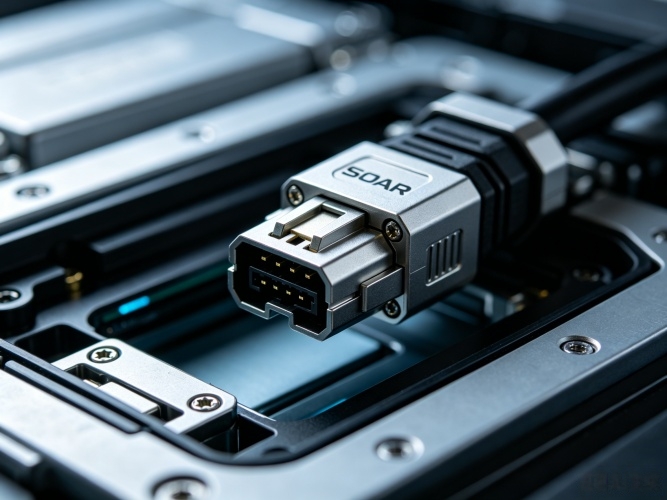
For external or under-the-hood applications, the primary enemy of a wiring harness is moisture ingress. Capillary action can pull moisture through a wire, leading to internal corrosion that is invisible to the naked eye until the circuit fails.
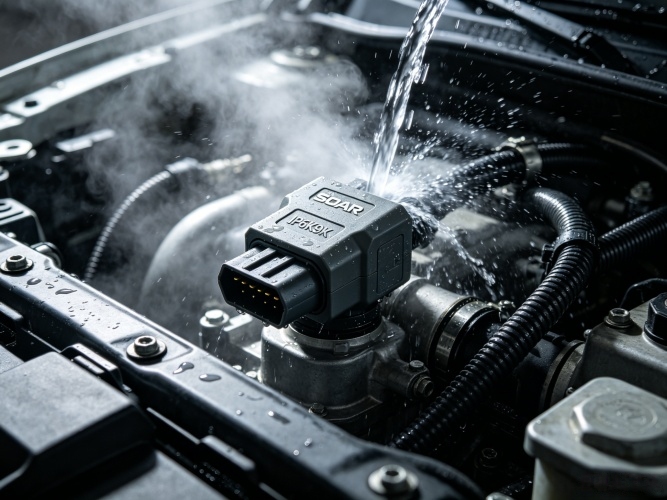
Custom automotive connectors must adhere to rigorous Ingress Protection (IP) ratings. While IP67 is standard for many industrial uses, the automotive industry frequently demands IP6K9K—the ability to withstand high-pressure, high-temperature steam cleaning.
| Feature | Standard Requirement | Custom SOAR Advantage |
|---|---|---|
| Operating Temperature | -40°C to +85°C | Up to +150°C for engine-mount sensors |
| Vibration Resistance | V1 (Chassis level) | V3/V4 (Engine/Powertrain mount) |
| Sealing Level | IP67 | IP68 / IP6K9K with triple-ribbed silicone seals |
| Mating Cycles | 10 - 20 cycles | High-durability alloys for diagnostic ports |
To achieve these levels of performance, custom connectors often utilize overmolding technology. By molding the connector housing directly onto the cable, manufacturers create a hermetic seal that eliminates the entry path for fluids, a critical requirement for sensors located in the wheel well or near the transmission.
As vehicle architecture shifts toward "Zone Control," the demand for hybrid connectors—those carrying both high-speed data and DC power—has surged. Traditional connectors often lack the EMI (Electromagnetic Interference) shielding required for these hybrid configurations.
From a manufacturing standpoint, the reliability of a connector is only as good as the crimp that attaches it to the wire. In the production of SOAR automotive wire harnesses, precision tooling is used to achieve "gas-tight" crimps. This process displaces air between the wire strands and the terminal, preventing oxidation at the contact point.
A reputable manufacturer must demonstrate compliance with IATF 16949. This is not just a certification; it is a management philosophy that emphasizes defect prevention and the reduction of variation and waste in the supply chain. For an OEM project manager, verifying a supplier's "Cross-Section Analysis" capability is vital. This involves cutting a crimped terminal in half and examining it under a microscope to ensure the compression ratio meets USCAR-21 standards.
When moving from a prototype to mass production, the commercial considerations for custom connectors shift toward scalability and long-term reliability. Engineers and procurement teams should evaluate the following factors:
For companies seeking to optimize their harness designs, SOAR's specialized automotive solutions provide the necessary technical depth. Their focus on custom overmolding and high-retention terminal systems addresses the specific failure points commonly found in standard industrial-grade connectors used in automotive contexts.
The evolution of the "Software Defined Vehicle" relies heavily on the physical layer—the connectors and wires that provide the pulse of the machine. By prioritizing SOAR custom automotive wiring connectors, engineers ensure that their systems are protected against the harsh realities of the road. Reliability is not an added feature; it is the result of meticulous material selection, precise manufacturing tolerances, and a deep understanding of the automotive environment.
Q: Why can't I use standard industrial connectors in a vehicle?
A: Industrial connectors are often designed for static environments. Automotive connectors must handle "G-load" vibrations, chemical exposure (fuel/oil), and extreme temperature swings that would cause standard plastic housings to embrittle and metal contacts to undergo fretting corrosion.
Q: What is "Fretting Corrosion" and how do custom connectors prevent it?
A: Fretting is a wear mechanism caused by microscopic movements between mating contacts, usually due to vibration. It creates a buildup of non-conductive oxide film. Custom automotive connectors prevent this through high-pressure contact designs and specialized lubricants or gold plating.
Q: What is the typical lead time for custom connector tooling?
A: Depending on the complexity, initial samples from 3D-printed prototypes can be available in 1–2 weeks. However, high-volume injection mold tooling typically requires 6–10 weeks for fabrication and validation (PPAP process).
Q: Are custom connectors more expensive than off-the-shelf parts?
A: While the unit price or tooling cost may be higher initially, custom connectors often reduce total system costs by simplifying assembly, reducing the need for additional adapters, and preventing expensive warranty claims related to connection failures.


