

2026-11-13
Automotive wire harness cost depends on the components specified, the work needed to assemble them, the inspection scope and the order quantity. Two harnesses with similar connectors and overall lengths can carry different prices because their internal wiring, protection and production requirements differ.
For OEM procurement, compare the recurring unit price, one-time project charges and delivery-related costs separately. This makes it easier to understand a quotation and identify changes worth reviewing.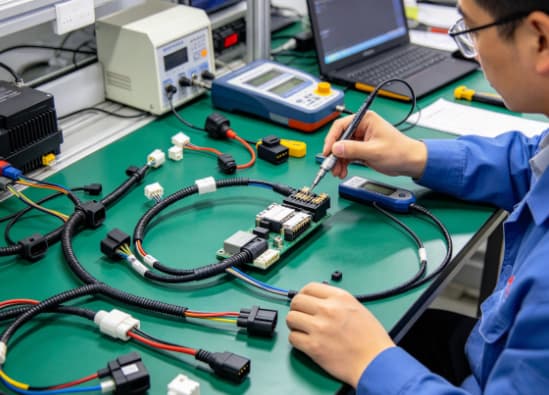
A useful cost breakdown connects each requirement to its effect on materials, processing or project setup.
| Cost factor | What affects the price | What buyers should confirm |
|---|---|---|
| Wire and insulation | Total conductor length, cross-section, shielding and material requirements | Wire specifications and lengths for every circuit |
| Connectors and terminals | Contact count, sealing, approved part numbers and sourcing availability | Exact components and any proposed alternatives |
| Assembly work | Terminations, splices, branches, wrapping and manual handling | The finished layout and required operations |
| Protection and molding | Sleeves, conduit, grommets, strain relief and custom overmolds | Required protection and separate tooling charges |
| Testing and records | Test coverage, fixtures, validation and reporting | Included checks, records and external test fees |
| Production quantity | Setup allocation, component purchasing and batch scheduling | Price breaks for the same approved configuration |
Overall harness length is different from total wire consumption. A one-meter assembly carrying multiple circuits uses more conductor than a single-wire lead of the same length. Branches, service loops and routing allowances also change material use.
Assembly work matters just as much. Additional terminals, splices, seals and wrapping points create more processing and inspection steps. Tight breakout spacing or difficult connector access can increase handling time.
For example, SOAR’s SAE J1939 9-pin Y cable assembly should be quoted against its actual branch layout, pin mapping and protection requirements. A straight extension is not a like-for-like price comparison.
Multiple harness variants can also affect inventory and production planning. Siemens’ analysis of wire harness variation costs explains the trade-off between individual harness content and the cost of managing different versions. Consolidating variants may simplify supply, but adding unnecessary circuits to every unit can increase material cost.

Ask whether the quotation separates recurring production costs from non-recurring engineering, tooling and test-fixture charges. These may cover custom molds, assembly boards, crimp tooling, test adapters or initial programming.
For budgeting, use:
Evaluated unit cost = recurring unit price + one-time charges ÷ planned quantity + additional delivery costs per unit.
Only add costs that are not already included in the quoted unit price.
As a hypothetical example, a $600 tooling charge contributes $2 per unit across 300 units, or $0.50 across 1,200 units. This illustrates cost allocation, not a SOAR price or a guaranteed volume discount. Payment for the tooling may still be due upfront.
Continuity testing, dimensional inspection, traceability records and application-specific validation require different resources. A quotation should distinguish routine production checks from one-time qualification work and externally performed tests.
If additional workmanship controls are requested, identify the applicable requirements. The NASA-STD-8739.4 workmanship standard concerns critical cable and harness work; it is not automatically required for automotive production.
The UL Solutions Wiring Harness Traceability Program provides background on tracking cable through the supply chain. Where traceability coverage is required, confirm the relevant scope and documentation instead of assuming it is included in every quotation.
To compare automotive wire harness cost fairly, give each supplier the same drawing revision, BOM, quantities and inspection requirements. Check currency, quotation validity, packaging, freight and delivery terms. Identify exclusions such as special testing, tooling or unused custom material.
Then review potential savings with engineering approval:
Record the revised specification and ask for a requote. Changes to conductor size, sealing or shielding need technical validation; compare the saving with any redesign and requalification costs.
Small builds spread setup, procurement and documentation work across fewer units. Confirm which charges apply again to production orders.
No. Purchasing and setup efficiencies may help, but component availability, custom-material commitments and delivery schedules can limit savings.
A photograph can support an initial discussion. A firm quote normally needs component references, wiring details, dimensions, quantities and the inspection scope.
Use SOAR’s automotive wire harness collection and electronic wire harness collection to identify a relevant product family. Then request a harness quotation with your drawing, BOM, quantities and required records. Ask for unit prices, one-time charges and exclusions to be shown separately.


